October 22, 2025
How Leaders Master Personal Efficiency Through Story

Every leader wants to do more, but the secret to high performance is knowing how to do less, better. The typical productivity advice often fails leaders because it’s tactical, not transformative. It gives you a new app or a new system but doesn’t address the underlying mindset. This article reveals how we help leaders master personal efficiency through the power of storytelling and behavior-change frameworks turning reflection into focused, sustainable action.
Key Takeaways
- Personal efficiency isn’t about managing time; it’s about managing your energy and focus.
- The most significant barrier to efficiency is often a leader’s own mindset and habits, which are best addressed through narrative and reflection.
- Lasting behavioral change starts with an emotional connection to a new idea, something that stories are uniquely able to create.
- True efficiency comes from a system that clarifies priorities, protects mental energy, and anchors new behaviors in daily rituals.
- When leaders model personal efficiency, they create a ripple effect of focus and clarity throughout their teams, boosting overall performance.

Why Personal Efficiency Is a Leadership Game-Changer
Efficiency isn’t about cramming more tasks into your day. It’s about choosing what really matters and having the focused energy to deliver it with excellence. For leaders, this is a non-negotiable skill. Business people also benefit greatly from personal efficiency, as it helps them prioritise tasks, manage resources and balance personal and professional responsibilities to drive productivity and growth.
Everyone, regardless of role or background, can improve their personal efficiency by adopting the right strategies.
The Cost of Inefficient Leadership
When leaders are pulled in a dozen different directions, the costs are huge. They suffer from decision fatigue, are reactive all the time and their focus is scattered. This chaotic energy trickles down to their teams and results in low trust, slow action and no clear priorities. An inefficient leader not only burns themselves out but also creates a huge opportunity cost; every minute wasted on low-impact activities is a minute stolen from strategic goals and meaningful impact.
What True Efficiency Looks LikeTrue efficiency is about clarity over urgency. It’s about knowing your three non-negotiable outcomes for the week and fiercely protecting the time and energy needed to achieve them. To maximise impact, identify the right times to focus on these outcomes, so your efforts align with moments of peak productivity.
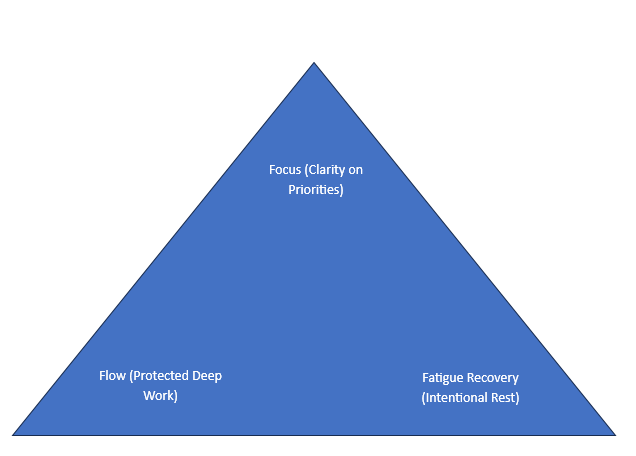
It’s a shift from being busy to being impactful. This means making purpose-driven choices that energise, not deplete, you and your team. We often visualise this as an “Efficiency Triangle,” where peak performance is the result of balancing sharp Focus, deep Flow, and intentional Fatigue Recovery.
Self Assessment: Where Are You on the Efficiency Spectrum?
Before you can improve your personal efficiency, you need to know where you are. Self-assessment is the first step for anyone looking to boost their effectiveness, whether in business, leadership or daily life. It’s a powerful way to identify your strengths, uncover hidden obstacles and create a clear plan to improve your productivity and well-being.
Personal effectiveness is the foundation of personal efficiency. It’s not just about how much you do, but how well you use your time, energy and skills to achieve your most important goals. To start, ask yourself: What is personal efficiency for you? Is it about work life balance, achieving more in less time or simply feeling less overwhelmed by your to-do list? The answer will help you focus on the right areas for growth.
A practical self-assessment begins with honest reflection. Evaluate your time management skills: Are you using effective time management techniques such as batching similar tasks, using a “do not disturb” mode or leveraging a task manager app to organise your day? Consider your goal setting: Do you set clear, actionable goals that align with your personal and professional priorities? And what about your decision making are you able to make choices quickly and confidently or do you get stuck in analysis paralysis?
To improve your personal efficiency try these self-assessment strategies:
- Track your time: Use a journal, spreadsheet or productivity app to log how you spend your time for a week. Look for patterns when are you most productive and what are your biggest distractions?
- Review your goals: List your current goals and rate how aligned they are with your values and long-term vision. Are you focusing on the most impactful tasks or getting lost in busywork
- Analyze your decision making: Reflect on recent decisions. Did you use a structured approach, such as a pros and cons list or decision tree? Did you seek feedback from others when needed?
- Assess your boundaries: Are you able to say no to low-priority requests or do you let e mail and social media interruptions steal your focus?
- Evaluate your well being: Are you building in time for rest and recovery or are you running on empty?
By answering these questions you can see where your personal efficiency is strong and where it can be improved. Use tools such as task managers, goal-setting worksheets or self-assessment checklists to help you stay organised and on track. Don’t be afraid to seek feedback from trusted colleagues, mentors or even your team, sometimes others can see issues and opportunities that you might miss.
Key takeaways from this section:
- Personal effectiveness is the foundation of personal efficiency.
- Effective time management, goal setting and decision making are essential skills for everyone.
- Self-assessment helps you identify strengths, weaknesses and opportunities for growth.
- Using tools like journals, productivity apps and feedback from others can speed up your progress.
- Regular self-assessment keeps you focused on the right tasks and helps you achieve your goals in both your personal and professional life.
Remember, improving your personal efficiency is a journey not a one-time event. By making self-assessment a habit you can continually refine your approach, overcome new challenges and create a work life that is both productive and fulfilling. Start today, your future self will thank you.
Story as a Catalyst for Behavioral Efficiency
You can’t change your habits with a to-do list alone. Lasting change starts with identity how you see yourself as a leader. A person can improve their personal efficiency by focusing on self-awareness and personal growth. And nothing unlocks a shift in identity faster than a story.
The Power of Story in Rewiring Habits Neuroscience shows that stories are one of the most powerful ways to activate our brains. Unlike data, which activates only the language-processing parts of the brain, stories engage our emotional and sensory regions, making the messages we hear more memorable and impactful.
A well-told story builds a bridge for reflection and that reflection is what triggers intentionality. Through these lessons leaders can learn to adopt new habits and mindsets and grow and adapt. As I’ve seen time and again, leaders remember what they feel far more than what they are told.
Kenneth Kwan’s Approach: From Story to Shift
My approach, Kenneth Kwan, is to use story as the entry point for change. During a keynote or workshop, Kenneth shares stories that challenge the assumptions leaders have about their time, their identity and their impact. Using humor, tension and vulnerability he makes the lessons relatable and actionable. For example the story of a leader who transformed his workday from 12 hours of chaos into focused four-hour clarity blocks doesn’t just offer a tactic; it highlights the use of a specific technique such as time-blocking to achieve this change. This makes leaders believe a different way of working is possible for them too.
The Deepimpact Model: Building Efficiency from the Inside Out
Other programs teach tools. We help leaders change the way they think so they can change the way they lead. By improving personal efficiency at the individual level leaders can drive greater efficiency and effectiveness within the organisation as a whole. Our model is a progressive three-step journey from mindset to mastery.
Step 1: Start with the Story
The journey begins with a keynote experience delivered by Kenneth Kwan. This session is designed to surface the limiting beliefs leaders hold about their relationship with time and productivity. The goal is to create an emotional resonance that drives curiosity and a genuine openness to change.
To be an effective and efficient leader means developing the mindset and qualities necessary to achieve personal and professional success. Leaders leave not with a list of hacks but with a powerful question: “What am I really here to do?”
Step 2: Train the Habits
That MatterWith the mind opened by story we move to building solution-focused habits. Our framework is simple: clarify priorities, protect your mental energy and design your day with intention. Through practical exercises leaders identify their unique energy leaks and distraction triggers.
There are many things leaders can do to reinforce new habits and improve their daily routines such as experimenting with different activities, experiences or actions that support their goals. We then help them install behavioral anchors, like a morning reset ritual or intentional transitions between meetings, to build forward momentum.
Step 3: Create a Personal Efficiency System
Finally we help leaders build a sustainable personal efficiency system. We guide them on the path to developing a sustainable personal efficiency system, ensuring each step leads to the desired outcome. This means creating weekly planning routines that are tied to outcomes not just effort.
Crucially we teach them how to model this efficiency for their teams by transforming the way they run meetings, manage emails and conduct coaching conversations. This creates a ripple effect, scaling personal efficiency into team effectiveness.
Measurable Impact: What Clients Experience
The goal of this work is not just to feel better but to perform better. The impact is real and measurable. Enhanced personal efficiency can significantly boost a leader’s career trajectory and open up new opportunities for advancement and professional success.
Case Snapshot: Regional Sales Director Turnaround
One regional sales director was working 14 hour days, attending up to 6 internal meetings a day and constantly firefighting. He felt perpetually behind. After attending a keynote from Kenneth on “why busyness is the enemy of greatness” he implemented our framework. The result? He now works in focused four-hour blocks, concentrates on three core goals and saw his team’s sales lift by 18% in 90 days.
What Our Clients Say
“Kenneth didn’t just teach us efficiency, he made us feel why it matters.”
“For the first time I’m building my day around results not reactions.”
“This changed how I lead, and how I live.”
Why Personal Efficiency Must Be a Leadership Priority

In today’s demanding environment a leader’s personal efficiency is directly linked to organisational health and success. In the workplace personal efficiency plays a crucial role in driving team performance and achieving organisational goals.
The Business Case for Efficient LeadersResearch shows a clear link between leadership focus and business outcomes. Recent research from Harvard Business School highlights that the way leaders behave and allocate their time has direct consequences for firm productivity.
When leaders model personal efficiency they also model clarity, trust and focus for their teams which are the key drivers of high performance. It’s a clear demonstration that the best leaders manage their energy not just their time. A leader or organisation can be effective without being efficient and vice versa but the optimal scenario is to balance both.
Scaling the Shift Across Teams
When leaders become more efficient they create a culture of focus. Meetings become shorter and more decisive, deliverables become clearer and team members feel a greater sense of ownership. A leader who models task simplicity, emotional resilience and clear boundaries gives their team permission to do the same.
People with strong personal effectiveness skills are motivated, organized and resilient which positively influences team performance and drives organisational success. This resilient efficiency is a powerful driver of both employee retention and sustained performance.
True personal efficiency is not about adding more life hacks to an already overflowing plate. It’s about intentionally subtracting what doesn’t serve your purpose to make room for what does. If you want your leaders to operate at their best let us show them how to master their inner world through story and structure. Our clients don’t just get more productive, they become clearer, calmer and more impactful leaders.
Visualizations
- Visual #1: The Efficiency Triangle
Story (Mindset Shift) → Habits (Behavioral Anchors) → Structure (Weekly Routines) → Impact (Measurable Results)
Also read: Leveraging Diversity for Leadership Impact and Team Performance