Leadership development can look busy.
The calendar fills up, the feedback forms look positive, and people leave the room with good intentions. Then regular day arrives, meetings still drag, escalations still happen, and managers still avoid the one conversation that would have changed the week.
I have watched this pattern across government agencies, Multi-National Companies (MNCs) and large regional organisations in Singapore and Asia. Not because leaders do not care, and not because the content is “WRONG”.
It is because most leadership development programmes try to upgrade thinking, without hardwiring daily behaviour, leadership practices and practical leadership skills inside real work. If you want developing leadership to stick, you have to make the skills repeatable, not just memorable.
Most leadership development programmes assume that inspiration will naturally convert into behaviour change. That is a fallacy.
People leave with language, models, and good intentions, but their environment has not changed. The meeting cadence is the same, the escalation habits are the same, and the unspoken rules about what is “safe” to say are the same. So the old behaviour wins, quietly, consistently and without drama.
In many organisations, the leadership strategy is implied rather than explicit. So leaders default to what feels urgent instead of what strengthens leadership competencies, builds leadership abilities, and creates effective leadership in the moments that matter.
In my experience, that is the hidden difference between good leader intentions and the behaviour of successful leaders.
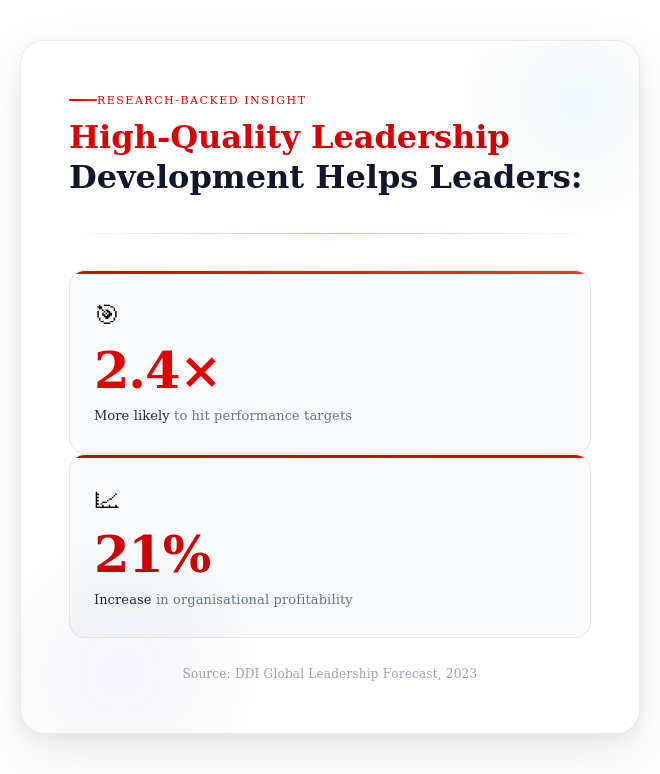
Organisations with high-quality leadership development are 2.4 times more likely to hit performance targets and often see a 21% increase in profitability.
Leadership development programs should be linked to business strategy to ensure effectiveness.
Measuring the impact of leadership development programs can include both quantitative and qualitative data.
This is also where buy-in quietly fails. Not because leaders disagree with the programme, but because the organisation has not made support, resources, and time visible enough to implement the behaviour in the workload, across different departments, without managers having to improvise.
Here’s the reality as I see it.
Leadership development is not a content problem. It is a behaviour design problem, and it sits inside the organisational context leaders operate every day, including the management habits that shape what gets rewarded.
When I speak with senior leaders, I often ask a simple but revealing question: “In two weeks, how will I see that this has truly landed?” Not, “How will you feel?” Not, “What will you understand?” I mean, what will be visibly different in the way you run a meeting, make a decision, or respond under pressure that shows you’re leading effectively at the C-suite level.
McKinsey put this plainly when they wrote that leadership development should focus explicitly on helping individual leaders become better at their daily jobs, with emphasis on on-the-job learning and repetition, not classroom learning that never shows up in real work. According to McKinsey (2020), many organisations still overemphasise classroom learning rather than on-the-job application and feedback, which leads to little behavioural change.
Training and development at Deep Impact are never treated as isolated events. The real value of any leadership programme lies in what happens after the workshop ends. That is why equal emphasis is placed on the application of learning, not just the learning itself.
Participants are encouraged to work on real business challenges drawn directly from their roles and apply the skills they have learned over a period of six to twelve months. Rather than leaving the classroom with ideas alone, they return to their teams with practical actions they can test, refine, and implement in their everyday work.
This approach ensures that learning does not remain theoretical. Instead, leadership development becomes embedded in day-to-day operations leading to visible improvements in performance, stronger collaboration, and better business outcomes, which are ultimately what organisations care about most.
Success indicators for leadership development programs should be specific to the organisation and its unique performance measures.
Also, engagement data from leadership development programs can include participation rates and content interaction metrics.
That word, repetition, is where everything changes.
The learning experience has to be designed for the near future, not for the classroom. I am not trying to create a perfect workshop moment. I am trying to create a better Monday, with one behaviour that leaders can repeat, measure, and improve, so the learning turns into skills and new skills in real meetings.
Regular feedback and assessment during leadership development programs can help adjust lessons and content to address gaps.
An end-of-session satisfaction survey can provide feedback on the perceived value and effectiveness of the leadership development program.
I have seen great leaders do this without fuss. They choose a small leadership practice, they practise it, and they treat the feedback as data, not judgement.
No new programme. No new modules.
Focus on one visible behaviour, practice it in a real situation until it feels natural, and watch it build your core leadership skills.
Let me give you a moment I have seen more than once, one of those real life examples that shows how developing leadership actually happens.
I was speaking at a leadership session for a large organisation, and during the break a senior manager said, “I’ve attended so many leadership development programmes, I could teach them. But when things get tense, I still go back to old behaviours: chasing updates, pushing harder and fixing it myself.”
That person did not need more leadership theory. They did not need another leadership programme, or more leadership training content. They needed a smaller entry point that matched their leadership style under pressure, and a clear plan they would actually practise, one on one with their own habits.
So I asked, “Where does tension show up first for you?” They answered immediately, “Monday morning check-ins.”
A leadership development program should be grounded in a firm understanding of the organisation's unique values, challenges, and priorities.
We chose one behaviour for that one meeting, a shift in what they would do before speaking. They would pause, then ask one ownership question before giving their view. Not a script, not a performance. A simple move that changed the centre of gravity in the room, built self-awareness, and sharpened their communication skills without making it feel like training.
Identifying key business priorities is essential for shaping a leadership development program. Assessing training results is important to determine the effectiveness of the leadership program.
At that moment, the team leader's role shifted. The manager stopped carrying the whole meeting, and the team started carrying more of the work. That is a leadership role move you can see.
This is the Small Steps To Big Changes® idea in its simplest form. You do not change leadership by declaring a new identity. You change leadership by practising one small action consistently, until it becomes how you lead, even when you are working across different departments and supporting current teams.
I also noticed something else. The more they repeated the move, the more their leadership experience changed. They stopped performing “confidence” and started building trust through clarity, influence, and follow-through. That is not charisma. It is practise.
It sounds almost too simple, and that is why people dismiss it.
Senior leaders often tell me, “Kenneth, we are dealing with complexity. A small change feels insignificant.” I understand that reaction. When you carry responsibility, your mind looks for leverage. You want the move that changes the whole system.
But behaviour is how the system expresses itself, and it is how leadership roles become real in day-to-day decisions.
In my experience, different leadership styles show up most clearly under pressure, so leadership development has to work with reality, not with theory, and it has to build leadership skills that leaders can access when they are tired.
Another obstacle is time. Leaders do not resist leadership development because they hate growth. They resist it because they can smell initiative fatigue.
They have seen programmes arrive with energy, then fade, leaving them with another set of terms that nobody uses, and no new skills that stick.
Deloitte captured a version of this tension in the wider shift organisations are facing. According to Deloitte (2024), just 10% of respondents said their organisations were succeeding at making the shift toward “human sustainability”, even though leaders recognise the need to change, which tells you something important. Awareness is common. Follow-through is rarer, especially when leaders are trying to drive performance without changing the daily process, the management habits, and the support leaders need.
Choosing instructors with leadership experience can enhance the quality of a leadership development program.
Keeping training groups small allows for better support and connection among participants.
Integrating leadership development into the company's culture can help sustain the leadership knowledge and skills required.
And then there is the meeting reality.
Most organisations are trying to develop leaders inside days that are already overloaded. According to Harvard Business Review (2022), research shows about 70% of meetings keep employees from completing their work, and while meeting lengths decreased during the pandemic, the number of meetings attended rose. So leaders try to add leadership training on top of a schedule that is already straining, and they wonder why it does not stick.
This is why I push a different approach. Remember:
As a leader do not add leadership development to the workload. Put it inside the workload, in the moments that already happen, and use those moments to build leadership abilities through repetition, coaching, and simple skills practice.
Employees who trust their leaders are 4 times more likely to be engaged. Effective leaders help employees connect their daily tasks to the broader company mission, fostering a sense of purpose and commitment.
Developing a culture of continuous learning is one of the most forward-looking investments a company can make in an era marked by uncertainty and disruptive shifts.
Effective leadership development drives performance, making a lasting impact on the biggest challenges that organisations face.
If you want leadership development to lift employee engagement and employee satisfaction, you cannot treat it as an extra. You have to treat it as a practical way of working that improves effectiveness, one meeting at a time, and supports team engagement.

So what can be that small step?
Pick one recurring meeting you already have.
Not the most important one, the most frequent one.
Then decide one leadership behaviour you will practise there for the next ten working days. Keep it visible, so you can tell whether you did it. Keep it small, so you will actually do it when you are tired, rushed, or irritated, and so it supports a smooth transition from intention to action.
Mentoring provides access to the advice and feedback of experienced leaders, facilitating knowledge exchange and professional relationships.
Learning by experience is one of the most effective ways to improve leadership skills and measure effectiveness.
Here are three options that work because they are behavioural, not theoretical:
One, start with “what’s working” before you go to what’s broken. That is Focus on What’s Working, applied in real time, and it often lifts team engagement and helps with improving employee engagement without adding another initiative. It also makes it easier to encourage learning, because people are not immediately defending themselves.
Two, ask one better solution-focused question before you give your answer. That is The Question You Ask Matters, made practical, and it strengthens decision making by slowing down the rush to solutions. This is also a quiet form of coaching that helps managers practise leadership training inside live work, not in a classroom.
Three, close with ownership, “Who will take the next step, and by when?” Not in a harsh way. In a clarifying way, so the team leader role is shared rather than carried by one person, and so individual leaders know what to implement next, with a clear plan.
This is where motivation turns into action. You don’t wait to feel like the leader you want to be you practice the behaviour, and your identity gradually catches up.
That’s how leadership develops in today’s teams and, over time, shapes the next generation of leaders. It’s also how learning agility works in practice: small adjustments, repeated consistently, until better habits become your default.
Celebrating early wins and sharing success stories can reinforce desired leadership behaviors and encourage participation in development programs.
Successful leadership development programs often incorporate a variety of learning methods to cater to different learning styles.
360-degree feedback involves gathering input from colleagues and superiors to understand strengths and areas for improvement.
Effective leadership development should include formal training, on-the-job experiences, and peer support.
The 70-20-10 framework suggests that 70% of learning comes from on-the-job experiences, 20% from interactions with others, and 10% from formal training.
Leadership development optimises individual skills and strengths, empowering employees to contribute their best.
Leadership fosters benevolence, transparency, and integrity within the organisation, resulting in greater trust from employees toward their leaders.
Organisations that prioritise continuous learning can realise extraordinary potential; those that don't will stagnate.
If you want a clear, practical sign of success, look at how escalations change. When leaders consistently practice visible leadership behaviours, ownership stays closer to the work—and the business no longer depends on heroic fixes.
Expect some discomfort.
If you’re used to being the person with all the answers, asking better questions can feel slower at first. If you tend to jump straight into problems, opening with “what’s not working?” can feel naive until you see how it changes the tone of the room.
Also, expect inconsistency early on. Under pressure, your old habits will try to return. That is not failure; it’s information. It tells me the behaviour needs more repetition, not more complexity.
I’ve seen that effective leadership development drives performance and can provide a real competitive advantage but senior leadership support is essential for its success.
A keynote, an article, or even a powerful two-day offsite can open a window. In that window, people see themselves more clearly they notice the cost of their habitual ways and feel ready to make different choices.
What happens next depends on whether the organisation makes space for practice, inside real work, until new behaviour becomes normal.
That’s why I always tell event organisers and leaders who want to get the most value from a speaking engagement to do one thing well: help the team leave the room with one small, specific behaviour they will practise immediately and make that practice visible enough to sustain.
Want to make leadership development simple and actionable? Hire Kenneth Kwanto turn insights into behaviour that lasts.
Then the focus shifts from knowledge to commitment. Real change depends on leadership’s willingness to model and reinforce new behaviours. Senior leaders play a critical role by creating positive experiences and conversations that consistently reflect the behaviours they want others to adopt.
When leaders demonstrate these behaviours with consistency, others begin to follow. Over time, what started as a learning initiative gradually becomes part of how the organisation works and leads.
Keep it real. Tie it to everyday moments meetings, decisions, escalations, feedback. Focus on one behaviour and one better question, not a mountain of content.
Then the step was probably too big to repeat or too invisible to notice. Make it smaller, make it obvious, and give it time. That’s how Motivation Follows Action actually works.
Read More: 2026 Leadership Development Approaches for All Generations