Change in the workplace often feels like a tsunami a force so overwhelming that it sweeps away established routines, leaves uncertainty in its wake, and tests the resilience of both teams and leaders. Many organisations experience it: a department rolls out a new system and suddenly staff are unsure of priorities. Leaders scramble to manage expectations and clients begin to notice delays or errors. The temptation is to dive immediately into diagnosing problems, pointing out gaps, or fixing what isn’t working. While this may feel necessary, it often traps teams in the past and slows real progress. Change agents individuals who actively facilitate and support organisational change play a crucial role in guiding teams through these transitions.
A different approach flips the script. Instead of focusing on what’s wrong, it focuses on what’s possible. Instead of dwelling on failures, it builds on past wins. Instead of asking, “Why aren’t we doing better?”, the question becomes, “What would success look like, and how can it happen together?” This is the essence of solution-focused change training, transforming not just how teams adapt but how they thrive.
Change management training is essential for ensuring the overall success of a business by preparing teams effectively for organisational change, and change management training is important because it helps reduce resistance, minimises disruption and accelerates the adoption of new processes and technologies.
When change feels overwhelming, change management training reduces resistance to change by equipping employees with the necessary skills and knowledge to adapt, and it is critical to address concerns to foster engagement and ease transitions.
A structured process is necessary for successful change management, providing a systematic way to guide individuals and organisations through change. Change management training is also essential for leaders looking to cultivate a culture of innovation and adaptability.
One of the most common mistakes in change management is framing the conversation around problems. Leaders often begin by analysing resistance, gaps, or inefficiencies. While understanding the root causes has value, an excessive focus on problems can create a culture of limitation. It keeps the team tethered to past failures and distracts from envisioning a better future.
A more effective approach starts with imagining what a successful outcome would look like. Teams are invited to consider questions such as: “What will it feel like when this change is fully adopted? How will day-to-day work improve? How will clients benefit?” This reframing shifts the focus from obstacles to possibilities, and the energy within the team changes immediately.
Shifting to a possibility mindset fosters a deeper understanding of organisational dynamics and highlights the need for effective communication strategies, such as clear, consistent messaging and stakeholder engagement, to support successful change.
For example, when onboarding a new client, the team feels overwhelmed, concerned about making mistakes and managing an increased workload. Rather than beginning with a checklist of what is not working, the team reflects on occasions when similar processes have been successfully implemented.
The discussion focuses on: “What worked in that transition? How can it be replicated?” Concentrating on past successes produces a roadmap built on confidence rather than anxiety. As a result, the team becomes more engaged and motivated to embrace the change. Effective change management training develops both technical and soft skills necessary for new roles, ensuring employees are equipped to handle transitions.
This approach not only increases engagement but also supports skill development and professional development, which are key outcomes of effective change management training for employees.
Ultimately, this mindset shift supports continuous growth and aligns with the aims of change management training to build awareness about the need for change, provide practical strategies for managing resistance, and cultivate a culture of continuous improvement and innovation.

Engagement grows when employees understand the impact of their work beyond internal processes. One effective strategy is mapping the client journey. Teams examine every touchpoint where clients interact with the organisation and consider how proposed changes affect these experiences.
Incorporating stakeholder engagement and stakeholder analysis at this stage helps identify key individuals and groups, understand their influence and tailor communication and training to their needs. Collecting employee feedback through surveys and focus groups is also essential, as it provides valuable insights to improve both the client experience and change management training programs.
Connecting employees to client outcomes transforms perspective. Instead of asking, “Why do we have to do this differently?”, staff begin asking, “How can the client experience be improved?” This fosters ownership and accountability, turning staff into problem-solvers rather than mere implementers. Additionally, recognising that different stakeholders play different roles in guiding and adopting change highlights the need for varied training approaches to address their specific requirements.
Change can feel intimidating if treated as a single, overwhelming challenge. Breaking it into small, achievable steps creates momentum. Each step, however minor, is a victory that reinforces confidence and motivates the next action. Building momentum through small wins helps teams manage transitions effectively, making organisational change less daunting and more achievable.
Celebrating these small wins helps maintain focus, reduces anxiety, and generates a sense of progress. Success is measured not only in end results but also in the steady accumulation of daily achievements that demonstrate capability and reinforce motivation. Project teams and cross-functional teams play a crucial role in supporting change initiatives by fostering collaboration, aligning objectives, and ensuring that progress is shared across departments.
Structuring change into manageable stages allows teams to focus on what is achievable in the short term while maintaining sight of the broader objectives. Each completed task provides feedback and learning opportunities, allowing adjustments to be made early rather than later.
This iterative approach reduces the risk of errors, increases adaptability, and builds a culture where continuous improvement is valued. Restructuring teams and leadership development are important for sustaining momentum and adapting to change, as they help redefine roles, foster communication, and build the leadership skills necessary for ongoing success.
Psychologically, small wins trigger a sense of accomplishment and reinforce positive behaviours. Teams gain confidence in their ability to manage change, which encourages further engagement and initiative. Effective change management training enhances communication and collaboration among team members during transitions, supporting a smoother and more productive change process. Over time, these incremental successes compound, creating a visible trajectory of progress that motivates both individuals and the collective team.
Focusing on small, tangible steps also encourages clarity and prioritisation. When teams know which actions have the greatest impact and can see how each step contributes to the desired outcome, it becomes easier to allocate effort, manage resources, and maintain momentum. Small wins transform what might feel like an overwhelming challenge into a series of achievable milestones, instilling a sense of purpose and control throughout the change process.
Ultimately, building momentum through small wins is about creating a rhythm of success that sustains engagement, fosters confidence, and ensures that change is not only manageable but also rewarding. Change management training improves productivity and reduces downtime during transitions, making it a critical component of successful organisational change.
I use the DEEP Model for solution-focused change training. Unlike traditional change models that focus on problems, I emphasise what is already working and explore ways to do more of it. Rather than dwelling on mistakes or gaps, I guide teams to build on strengths, replicate successes, and create a clear vision of a preferred future.
I support the application of the DEEP Model through scenario-based learning and practical training, using interactive, role-specific modules and realistic simulations to help employees adapt effectively to change.
Using the DEEP Model involves four key steps:
Teams create a detailed picture of what success looks like in their preferred future. This includes not only the desired end results but also the daily experiences, behaviours,and interactions that will make the change rewarding and sustainable. Guide the team to imagine a clear and compelling picture of the future. Ask questions such as: “What will success look like? How will we feel as a team when this is achieved? How will our clients benefit?”
Discussing a preferred future shifts the focus from fear and uncertainty to motivation and possibility.
Teams reflect where they are on a scale of 1-10 based on their designed preferred future. This is a subjective scale where everyone could have a different opinion of where they are on this continuum. This helps them reflect on what they have done so far to get to where they are.
Teams reflect on instances where change has been managed effectively. Behaviours, decisions, and attitudes that contributed to these successes are identified. For example, collaborative problem-solving, proactive communication, or incremental improvements. Understanding what has worked well in the past allows teams to recognise repeatable patterns and reinforces confidence in their ability to adapt.
Once successful behaviours have been identified, I guide teams to deliberately replicate and apply them to the current change initiative. Each team member plans specific, actionable steps they can take to move the needle and achieve better results. New approaches can be tested in controlled settings, with lessons learned and adjustments made as needed. Focusing on small, incremental wins is key each success builds momentum and motivation to achieve more.
Applying the DEEP Model in this way makes change manageable, actionable, and motivating. It transforms abstract goals into practical behaviours, strengthens confidence, and helps teams sustain progress while fostering a culture of continuous improvement.
Engagement flourishes in environments that foster collaboration, positivity, and shared responsibility. Human resources professionals play a crucial role in supporting cultural transformation and organisational change by shaping shared values, fostering collaboration, and aligning HR and OD initiatives with broader company goals.
When teams feel supported and valued, they are more likely to embrace change, contribute ideas, and take initiative. A positive team culture does not emerge by chance; it is actively cultivated through consistent practices that encourage reflection, recognition, and collective learning.
Encouraging teams to reflect on past successes is a powerful way to reinforce engagement. When individuals acknowledge what has worked well, they gain confidence in their abilities and develop a mindset oriented towards solutions rather than problems. Reflection allows teams to identify behaviours and strategies that can be replicated, ensuring that success is reinforced and not left to chance.
Practising new behaviours in realistic scenarios strengthens competence and reduces anxiety around change. Role-playing, simulations, or guided exercises provide opportunities to apply new approaches in a safe environment, allowing teams to test strategies, learn from small mistakes, and internalise effective behaviours.
Change management activities and exercises promote open dialogue, build trust and transparency among employees, and can be tailored to suit various levels of employees, ensuring engagement across the organisation. These practical exercises transform abstract concepts into tangible skills that can be applied in day-to-day operations. Employee training, especially when supported by learning management systems, is essential for fostering engagement and reducing resistance to change during organisational change initiatives.
Recognition is another critical element in cultivating an engaged culture. Celebrating individual and team contributions reinforces positive behaviours and signals that effort and achievement are valued. Recognition need not be formal or elaborate; simple acknowledgements during team meetings, peer-to-peer appreciation, or highlighting progress against objectives can have a lasting impact on motivation and morale. Activities that promote empathy and understanding help build trust and reduce anxiety about organisational changes, further supporting a positive team environment.
Storytelling is a particularly effective tool in building culture. Sharing narratives that demonstrate the tangible impact of individual and collective actions on clients or organisational outcomes helps teams understand the purpose behind their work. It reinforces a sense of meaning and connection, reminding staff that their contributions matter and encouraging a proactive, solution-focused mindset. Highly engaged employees are 87% less likely to leave their companies, and engaged employees are less likely to resist change, highlighting the importance of employee engagement techniques in change management training.
Sustaining a positive, engaged team culture also requires consistency and reinforcement. Leaders play a vital role in modelling the behaviours they wish to see, maintaining open communication, and ensuring that recognition and reflection become embedded in daily practices. When engagement is nurtured in this way, teams approach change with confidence, resilience, and a shared commitment to success.
Ultimately, a positive culture transforms change from a source of stress into an opportunity for growth, learning, and achievement. Teams that feel connected, supported, and valued are more likely to adopt new processes, collaborate effectively, and maintain momentum, making change not only manageable but also rewarding.
Shifting from problem-focused thinking to solution-focused strategies transforms change from a source of anxiety into a source of energy. Agile business practices support adaptability and resilience during change, enabling organisations to respond quickly and effectively to new challenges.
When employees understand the role they play in shaping outcomes, they become proactive rather than reactive. Ownership, collaboration, and creative problem-solving naturally flourish in such an environment, creating a culture where challenges are viewed as opportunities for growth rather than obstacles. Effectively managing change and implementing change through structured processes ensures that everyone is aligned and engaged throughout the transition.
A solution-focused approach encourages teams to see change as a series of possibilities rather than a single overwhelming event. This mindset empowers employees to identify areas where they can make a tangible difference, experiment with new approaches, and take responsibility for outcomes. Over time, these small, deliberate actions compound, creating momentum and reinforcing confidence across the team.
These efforts positively affect both internal operations and client outcomes. Change handled in this way not only benefits internal operations but also improves client experience. Teams that are engaged, empowered, and motivated deliver higher-quality service, maintain consistency, and innovate more readily. When staff feel confident and purposeful, clients notice the difference in both interactions and outcomes, leading to stronger relationships, higher satisfaction, and increased trust.
Additionally, approaching change as an opportunity promotes resilience. Teams develop the ability to navigate uncertainty with composure, adapt quickly to evolving circumstances, and sustain performance even under pressure. Rather than fearing setbacks, employees learn to view them as learning moments and stepping stones toward improvement.
Ultimately, this approach transforms what once seemed like an overwhelming tsunami into a wave that teams can ride with confidence, clarity, and purpose. By focusing on strengths, small wins, and achievable goals, change becomes a catalyst for growth, innovation, and long-term success.
Change management training equips leaders, managers, and employees with the knowledge, skills, and tools needed to adopt and sustain organisational change. The ultimate goal of change management training is to prepare, equip, and support people through their change journeys, ultimately leading to improved organisational performance and meaningful value for both the organisation and its clients.
Teams not only survive the transition but thrive in ways that deliver meaningful value to both the organisation and its clients.
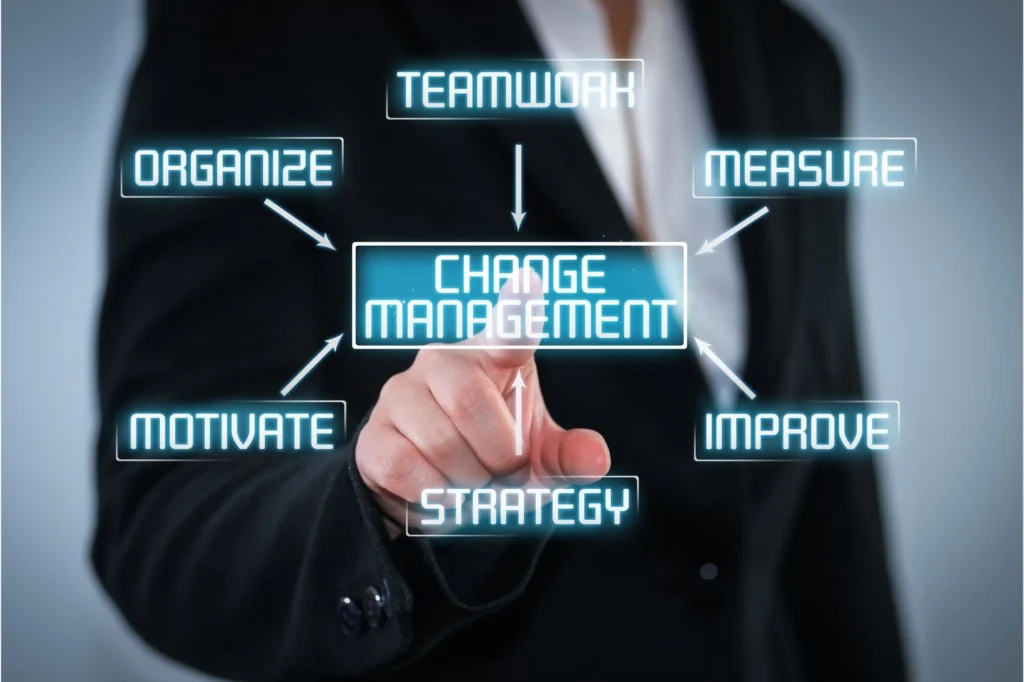
Years of experience reveal that guiding teams successfully through change requires more than procedures it requires a mindset, a clear direction, and deliberate actions that build confidence and engagement. Implementing change management training for employees is most effective when approached as a structured process, systematically preparing and supporting individuals through each stage of change. The first step is clarifying the vision: defining what success looks like and creating a compelling picture of the preferred future.
This clarity provides teams with direction, purpose, and the motivation to act, helping them understand not just what needs to be done, but why it matters. Equally important is reflecting on past successes. Teams benefit from recognising moments when they have adapted effectively in the past, analysing the behaviours, decisions, and mindsets that contributed to those wins, and using these insights to inform current change initiatives.
Connecting these actions to the broader organisational or client impact is another critical step. Mapping the client journey enables employees to see how their daily contributions influence outcomes, increasing engagement and fostering accountability.
Breaking change into small, manageable steps ensures progress feels achievable. Each milestone, no matter how minor, represents a tangible success and builds momentum for the next stage, reinforcing confidence and sustaining motivation. Equally vital is the cultivation of a positive team culture.
Offering a well-designed training course in change management, along with a variety of training methods, helps employees develop practical skills for implementing and communicating change initiatives. Incorporating evaluation methods, such as surveys and practical assessments, is essential to measure participants' understanding and application of learned concepts.
Encouraging collaboration, recognition, and storytelling ensures that achievements are celebrated, behaviours are reinforced, and employees feel valued and supported throughout the change process.
Applying the DEEP Model turns reflection and observation into action. Identifying what works, scaling effective behaviours, and visualising a fulfilling future gives teams a practical roadmap for achieving change while staying focused on strengths and possibilities rather than problems.
Combined, these steps create a structured yet flexible approach to change, keeping teams motivated, engaged, and aligned with organisational goals while transforming potentially daunting transitions into opportunities for growth, learning, and lasting impact. Continuous feedback collection and ongoing support, such as coaching and mentoring after initial training, further reinforce learning and ensure the successful application of change management skills.
The most successful teams do not simply survive change they thrive in it. Comprehensive change management training is crucial for project teams, as it equips collaborative groups such as project managers, agile squads, and organisational leaders to drive and support change initiatives effectively.
Consistent, solution-focused practice is essential for creating an environment where employees are empowered to contribute, innovate, and adapt. Leaders who encourage reflection, celebrate small wins, and maintain a forward-looking mindset cultivate teams that feel energised rather than anxious. In fact, organisations with excellent change management training are seven times more likely to achieve their objectives compared to those with poor change management.
One key lesson is that change is most effective when it builds on existing strengths rather than focusing solely on problems. Teams that understand and leverage what already works are more confident in navigating new challenges, and this confidence fosters a culture of curiosity, experimentation, and resilience. Reflecting on past successes reinforces what is possible and provides practical strategies that can be applied to current and future initiatives.
Another important insight is that engagement is driven by ownership and clarity of purpose. When staff understand how their actions contribute to team and client outcomes, they are more likely to participate actively and take responsibility for results. Solution-focused change management training helps individuals see opportunities within challenges, transforming potential obstacles into actionable steps that deliver real value. Role-based training is essential for successful change outcomes, as different stakeholders have varying responsibilities during change initiatives.
Teams that initially resist change often evolve into proactive, confident, and client-centred units. They collaborate more effectively, share insights freely, and innovate with purpose. Over time, these behaviours become embedded within the culture, creating a self-reinforcing cycle of success.
Employees develop resilience, adaptability, and a sense of achievement that extends beyond individual projects to influence broader organisational performance.
A further lesson is that leadership plays a pivotal role in sustaining a solution-focused mindset. Leaders who model curiosity, maintain a positive outlook, and recognise progress at every stage help reinforce the behaviours necessary for successful change. By framing challenges as opportunities for growth rather than threats, leaders encourage teams to embrace change with confidence and creativity.
Ultimately, solution-focused change training teaches that transformation is not simply about implementing new processes it is about cultivating the behaviours, mindsets, and culture that allow teams to thrive. Change becomes an opportunity for learning, growth, and achievement, turning uncertainty into motivation and setting the stage for long-term success.
Measuring the success of change management training is essential for organisations committed to continuous improvement and long-term success. Effective change management training programs are designed not just to introduce new concepts, but to equip team members with the practical skills and confidence needed to navigate the change process and drive successful change initiatives. But how can organisations know if their investment in management training is truly making a difference?
The answer lies in setting clear objectives for each change management training program and tracking progress against those goals. Change management training aims to foster employee engagement, reduce resistance, and build a culture of collaboration and adaptability. By defining what success looks like from the outset, organisations can more easily measure the impact of their training efforts.
Key performance indicators (KPIs) provide a structured way to evaluate the effectiveness of change management training. Metrics such as employee engagement, participation in the change process, and retention rates offer insight into how well team members are adapting. A reduction in resistance to change, improved communication skills, and increased collaboration among team members are all signs that the training program is having a positive effect. Additionally, organisations often see gains in productivity and efficiency, as well as reductions in costs associated with implementing new processes.
One example of a large public hospital we worked with. the senior leaders identified three key performance indicators that was important: Patient Safety, Patient Experience and Throughput (a measurement of how fast paitents went through the system and go back home). Different organisations measure different KPIs and it is important to ensure that the change initiatives actually contribute and deliver directly to it.
Collecting employee feedback is another critical component of measuring success. Regular surveys, feedback sessions, and open forums allow organisations to gather input directly from those experiencing the change. This feedback not only highlights areas where the training program is working well but also identifies opportunities for further development. By listening to team members and addressing their concerns, organisations can refine their change management training programs and better support employees throughout the transition.
Many organisations invest in a range of change management training courses. These training sessions provide both theoretical knowledge and practical skills, enabling participants to apply what they have learned to real-world scenarios and complex change initiatives. Deep Impact focuses on excelling on the human side of change.
Ultimately, the effectiveness of change management training is measured by its ability to equip employees to embrace change, support project objectives, and contribute to successful change outcomes. By continuously evaluating training methods, collecting data, and making informed adjustments, organisations can build a resilient management system that supports ongoing organisational development and talent management. This commitment to continuous learning and improvement ensures that the entire organisation is prepared to manage change, achieve business objectives, and thrive in an ever-evolving environment.
Taming the tsunami of change requires clarity, focus, and deliberate action. Teams thrive when they envision success, reflect on past wins, and identify small, intentional steps that lead to meaningful outcomes.
Applying the DEEP Model ensures behaviours are anchored in practical achievements rather than hypothetical problems, providing a solid foundation for continued progress. Celebrating each success, however small, nurtures a culture of curiosity, collaboration, and resilience that sustains momentum throughout the organisation. Change management training for employees supports continuous growth and professional development, ensuring that learning and adaptability are ongoing priorities.
When approached in this way, change becomes an opportunity to grow, excel, and deliver greater value to clients. Every step forward is a victory, and each small win reinforces confidence, strengthens engagement, and inspires further action. Teams learn that they have the capability to shape outcomes rather than simply respond to them, and that their contributions directly influence organisational success.
Change does not need to be a tsunami that overwhelms teams. Through a solution-focused approach centred on possibility, engagement, small wins, and the DEEP Model change transforms into a wave that empowers, energises, and drives meaningful results. Leaders who embrace these principles guide their teams not merely to survive transitions, but to thrive through them.
Read more: From Theory to Implementation: Do Change Management Frameworks Work Across Organisations?